TABLE OF
CONTENTS
Table of Contents................................................................................................................................................................... 1
Computer Games in
Move Generation with
Perfect Hash Functions (Trevor Fenner and Mark Levene).................................................. 3
A Survey of NP-Complete
Puzzles (Graham Kendall, Andrew J. Parkes, and Kristian Spoerer).......................... 13
Review: .................................................................................................................................................................................. 35
If Chess was like Pool, a Knight
could be off by a Whisker (
Information for Contributors............................................................................................................................................. 37
News,
Information, Tournaments, and Reports: ........................................................................................................... 38
The 12th Game Programming
Workshop (
Crazy Stone Wins the First UEC Cup (
The 17th International
The Complete Chess Match 2008 (Erwin l’Ami, Daniël Stellwagen, Jan van Reek and Jos Uiterwijk) 47
The 1st Computer Stratego World
Championship (Imer Satz)..................................................................... 50
The 16th World Computer-Chess
Championship (The Board of ICGA).................................................... 52
Rules for the 16th World Computer-Chess
Championship (The Board of ICGA).................................... 53
ICGA Triennial Meeting (The
Board of ICGA).............................................................................................. 55
Call for Participation Computer
Olympiad 2008........................................................................................... 58
ICGA Treasurer’s Report for 2007
(Hiroyuki Iida)........................................................................................ 59
The 2006 and 2007 ChessBase
Best-Publication Award Recipients (The Editorial Board).................. 60
The 2007 Herschberg
Best-annotation Award (The Editorial Board)........................................................ 61
Calendar of Computer-Games
Events in 2008.............................................................................................. 61
The Swedish Rating List (T.
Karlsson).............................................................................................................. 62
Correspondence: .................................................................................................................................................. 63
3-Hirn Grant for
Jakob Erdmann (Ingo Althöfer).......................................................................... 63
Second 3-Hirn
Grant (Ingo Althöfer)................................................................................................ 63
How the ICGA Journal Reaches You............................................................................................................................... 64
computer games in
The larger
the country, the more possibilities there are for creative computing. Chess,
Games, and Science are quite attractive ingredients of the three ICGA events in
The ICGA is
proud to have two “big brothers”, viz. FIDE[1]
and IOC[2],
which paved the way for our events. In Turin 2006, we were “sequentially
assembled” for the first time (IOC, FIDE, and ICGA). Now the ICGA is again
following the IOC. Our three events are modest in comparison to the human Chess
Olympiad and the Olympic Games for all sports, but the variety of thinking
games is a challenge in itself. In this issue Graham Kendall, Andrew Parkes,
and Kristian Spoerer show that the end of the list of one-person games (also
called puzzles) is not yet in sight, let alone, that this will be the case for
the many-person games. The established difficulty of many games guarantees a
large research interest for many years. For
The
publicity for the Olympic Games as made by the Chinese organizers of the
Olympic Games is also a stimulus for our participants. A brief investigation
brought in the following four themes: (1) Forever Friends, (2) Everyone is No.
1, (3) I am a Star, and (4) Our Dreams. Each of them could have served as an
appropriate title for this Editorial.
Of course,
this Journal is scientific by its origin, its nature, and by the contributors.
The two scientific articles show clear scientific progress by offering an
excellent survey of NP-Complete Puzzles and by discussing Perfect Hash
Functions. We are sure that many other proofs of concept will be experienced in
If we now
return to the four suggested editorial titles then we see the following. First,
we may dream of scientific progress.
According to the theory by Ray Kurzweil (on the singularity point; for a
definition, see the appropriate website) it may be remarked that we have seen
such a point in chess in 1997 when Kasparov was for the first time defeated by Deep Blue, a milestone in our
community. We then assumed that many milestones would follow soon. Meanwhile we
have seen milestones in Backgammon, Checkers, Othello and Scrabble, but
currently we may dream of progress in 9x9 Go. Your Editor looks forward to see
what
Second,
playing in the World Computer-Chess Championship or in the Computer Olympiad is
only for stars, as is participating
in the Computer Games Conference. For them, the right slogan clearly is: “We
are the Stars”. The challenge is with the ICGA and the local organizers to
treat all of you accordingly. We are sure that the organizers will do their
utmost.
Third, for
an appropriate service, it holds that “Everyone is No. 1”. In sport, science,
and business this should be changed into “Everyone would be No. 1”. That is
exactly why you come to
Over the
years, the ICGA has broadened its scope considerably. This is now the first
time (since 1977 when the ICCA started) that
Jaap van den Herik
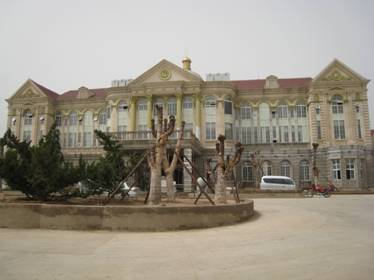
Venue
of the three events in

The
credits of the photographs in this issue are to: the Chinese Organisation (p.
2), Rémi Coulom (pp. 41, 43, 44), Tobias Tscheuscher (p. 46), and Eric van Reem
(p. 49).