TABLE OF CONTENTS
Table of Contents................................................................................................................................................................ 129
Go for a Breakthrough (H.J. van den Herik) .................................................................................................................... 129
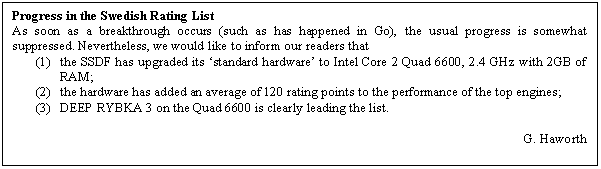
Progress in the Swedish Rating List (G. Haworth) ........................................................................................................ 130
How Trustworthy is Crafty’s Analysis of Chess Champions? (M. Guid, A. Perez, and I. Bratko) ................... 131
Cross-Entropy for Monte-Carlo Tree Search (G. Chaslot, M. Winands, I. Szita, and H.J. van den Herik) ........... 145
Note: .................................................................................................................................................................................... 157
The Compact Chessboard Representation (V. Vučković)............................................................................. 157
Information for Contributors.............................................................................................................................................. 165
News, Information, Tournaments, and Reports: ............................................................................................................ 166
The 16th World Computer-Chess Championship (O. David-Tabibi)............................................................ 166
The 2008 World Computer Speed-Chess Championship (O. David-Tabibi).............................................. 171
The 12th Annual World Computer-Bridge Championship (A. Levy) .......................................................... 172
Game Programming Forum (R. Coulom) ........................................................................................................... 178
Human Computer-Go Revolution 2008 (G. Chaslot, J-B. Hoock, A. Rimmel, O. Teytaud, C-S. Lee,
M-H. Wang, S-R. Tsai, and S-C. Hsu) ............................................................................................................. 179
The 13th Computer-Games Championship (H.J. van den Herik, M. Winands, and J. Hellemons) ........... 186
SIA wins Surakarta Tournament (M. Winands).................................................................................... 187
Tacos wins Shogi Tournament (T. Hashimoto).................................................................................. 188
Intella wins Chinese-Chess Tournament (J. Wang and X. Xu).................................................... 189
Calendar of Computer-Games Events 2008-2009............................................................................................. 190
The Swedish Rating List (T. Karlsson)............................................................................................................ 191
How the ICGA Journal Reaches You................................................................................................................................ 192
GO FOR A BREAKTHROUGH
With much pleasure I would like to congratulate a large team of French researchers that in a combined effort (cooperatively as well as competitively) achieved a milestone in the world of computer Go. Stories of successes are always interwoven with long lists of names, and the breakthrough in Go is no exception. It is hard to make an accurate record of the variety of contributions over the years. For me, the first step in the “breakthrough” direction was made by Bruno Bouzy when he suggested to apply Monte-Carlo search in competitive Go programs. In his habilitation thesis, he successfully defended his position as an advocate for Monte-Carlo search. Even more important is that he had many successors.
In 2006, Rémi Coulom surprised the Go community in Turin with his new findings at the conference, and with his implementations in the 9x9 and 19x19 tournaments. In the same year, a team in Paris started to study the game of Go in combination with the UCT algorithm and Monte-Carlo search.
A descendent of the French research group – he did his M.Sc. with Bruno Bouzy as supervisor – was Guillaume Chaslot who went to Maastricht to work in the GoForGo project. He brought with him the ideas developed by Bruno and himself, and refined them into the now established Monte-Carlo Tree Search method (MCTS).
From Maastricht, Guillaume strengthened the ties with the MoGo research group in Paris[1]. It became a success. In Amsterdam 2007, MoGo won the 19x19 competition and landed second in the 9x9 tournament (after Steenvreter by Erik van der Werf). For 2008, the signs were clear, all over the world there were activities, publications, and interesting research results.
In this issue a large team of authors describe the Human-Computer Go Revolution 2008. It is a fascinating story described in four sections and the end of the development is not in sight yet. The main breakthrough was achieved by the French-Dutch combination of (1) implemented ideas (as in MoGo) and (2) supply of computer power (as by the supercomputer Huygens). So, the new name of the program became MoGo Titan (a courtesy to Christian Huygens who discovered the moon around Saturn, which he called Titan). The computer was provided by the Dutch research organisation NCF[2] in cooperation with SARA[3].
On August 7, 2008 an official 9-stones handicap game was played between MoGo Titan and Kim Myungwan, an 8 dan professional. MoGo Titan won and this was the first time that a computer program (with a handicap of 9, the maximum) won a game in a direct encounter with a professional Go player of high calibre. From August 7, the challenge was to improve the number of handicap stones. After the game, Kim Myungwan stated: “it would even be difficult with eight stones”. So, Rémi Coulom took up that challenge and defeated Kaori Aoba, a 4 dan professional, in an 8-stones handicap game. Therefore MoGo Titan challenged Kim Myungwan again for a 7-stones handicap match. The computer played excellently, but lost in an advantageous endgame. We may thus conclude that still some work in MCTS has to be done.
The results in the human-computer Go matches inspired David Fotland to come back in the arena with a new version of his program Many Faces of Go. This time he brought a Champion Face to Beijing. Although Fotland had to suffer from two losses in the 9x9 tournament by MoGo, his program won both competitions (i.e., 9x9 and 19x19). A report on this breathtaking tournament will be published in the December issue of the Journal. Meanwhile the Editorial Board congratulates David Fotland with his successes and looks forward to seeing all the strong Go Programs in Pamplona, Spain for the next breakthrough.
Jaap van den Herik

The credits of the photographs in this issue are to: Reijer Grimbergen, Joke Hellemons, and Hans van der Zijden.